
In the previous article, you read all about the Early Modern Styles of Painting. Some Indian Painting styles are more than a thousand years old, while some originated and flourished during the reign of the Mughal Rulers and Rajput kings. Now, read here the contemporary painting styles spanning from post-war to the present day that the rural village and tribal artists have learned over generations and are still engaged to this day.
Contemporary Paintings

As the country progressed, leaving behind the rules of kings and queens, there was a cultural shift, where the artisan community developed several local traditional painting styles with different artistic approaches and genres.
Using painting as the medium of depicting celebrations, their homage to nature, the tribal and village artists are skilfully preparing these paintings and keeping their distinguished folk painting style alive.
Tribal Paintings
Warli Paintings

Hand-painted by the people hailing in the North Sahayadri region in Maharashtra, Warli painting is a tribal art form. Popularly known to have been originated in the state, this folk painting style is still practiced by the tribal people.
In Warli culture, the tribal people respect nature and wildlife for the resources each provides for sustaining life. Akin to their beliefs, the Warli artists hand-paint the walls depicting and worshipping Mother Nature and its elements while using their clay huts as the backdrop for the paintings.
They use basic geometric shapes to depict the elements; a circle representing the Sun and the moon, a triangle representing mountains and conical trees, a square to illustrate the human invention or a piece of land. Each painting has a square motif in the center which means ‘chauk’ or ‘chaukhat‘. It is surrounded by scenes that portray hunting, fishing, farming, trees and animals, i.e., nature’s elements and scenes of their livelihood. Warli artists paint special occasions such as weddings, festivals, dance and harvests to depict celebrations in their lives for the generations to see and learn from.
Painted on the inside walls of the huts, the Warli artists use only a mixture of rice flour, water and gum to form a white binding pigment. They use a chewed bamboo stick as a paintbrush.
Bhil artists paint pictures of everyday characters, their ancestors, and even deities, filling them with an overlay of uniform dot patterns.
Bhil Painting
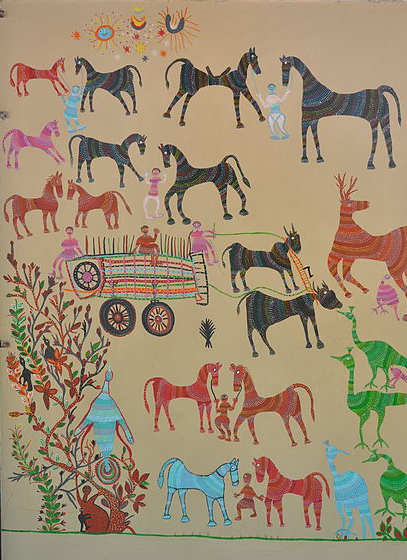
An intimate and striking painting style, it is a tribal art form hand-painted by the Bhil tribe folk located in western and central India, ie. In the states like Madhya Pradesh, Gujarat, Maharashtra and Rajasthan. Originated by the Bhil people (whose ancestry is said to date back to the archer Eklavaya and scholar Valmiki), the skill has traveled down generations and is still practiced with the same fervor. Undeniably, the people of Bhil tribes have come a long way keeping their skills, traditions, and their distinctive art form alive.
Painted on the clay walls of their village homes, Bhil paintings are the authentic depiction of life. As the Bhils are majorly an agrarian community, each of the paintings tells the tale of the land their connection with nature. From the depiction of people, animals, insects, deities, Sun, moon, Bhil artists exhibit the legends and folklore, celebrations, festivals, religious occasions, even birth and deaths in their paintings. Although the shapes the characters handpainted are less than perfect, the story each painting tells is honest to the core and showcases the truthfulness of life.
To prepare the imagery, Bhil artists use earthy yet bright colors. They use neem sticks, twigs, and natural dyes like Turmeric, flour, vegetables, leaves and oil. The eco-friendly pigments deliver brilliant colors that help the artists handpaint fascinating wall and floor paintings. Defined either by a distinctive color palette or theme, each Bhil Artist’s work is unique and notable.
Bhil artists paint pictures of everyday characters, their ancestors, and even deities, filling them with an overlay of uniform dot patterns.
Gond Paintings

Madhya Pradesh’s folk art form, Gond paintings, is one of the most valued treasures of the Gond tribal community’s culture. Traditionally the artists use natural colors to paint the images of animals, birds, festivals and rituals on the walls and floors of their houses. They believe that watching artistic images bring good luck and prosperity. Thus, they paint the walls exhibiting various festivals like Diwali and Nag Panchmi, celebrations like birth and marriage, and more on the walls of their houses.
Evolved from Digna and Bhittichitra, the present-day Gond paintings are painted on canvas, handmade and chart papers. Each Gond painting is distinctive and unique as it consists of the artist’s signature pattern or style. The Gond artists use decorative patterns to fill the images, from dots, straight lines, and curved lines to fish scales, drops of water, and geometric shapes. They use bright colors like red (obtained from geru soil), yellow (derived from ramraj soil), black color (obtained from charcoal), green (derived from cow dung and bean leaves). The artists paint the pictures in wonderfully contrasting colors that enchant and immediately affect the observer.
Today’s Gond artists readily use acrylic and poster colours against the colours extracted from natural sources like plants and coloured soils. Gond tribe believes that man’s life and nature are intertwined. The artists thus paint nature as the central theme, reflecting the close connection the two share. Therefore, the Gond paintings mainly constitute the habitats they live in; lush green mountains, flora and fauna, their culture, and the deities they worship. The pictures of animals and birds like tigers, snakes, peacocks, local deities like Phulvari Devi and Jalharin Devi, Hindu Gods like Lord Shiva and Ganesh, Mahua Tree, the daily life of the Gond people, folktales are hence quite evident in Gond paintings.
The Gond paintings bears a striking resemblance with the aboriginal art from Australia.
Rural Paintings
Chittara Paintings

Crafted by the womenfolk of the Deevaru community, Chittara painting is an indigenous art practice, an embodiment of the socio-cultural value they hold.
This painting style exhibits intricate geometric patterns, representing auspicious rituals of life and ceremonies. These paintings are usually 2-3 feet in size. Chittara painting is a skillful art that requires a sound knowledge of ratios and proportions. The women have been using this self-learned ability to create aesthetically refined paintings.
Deevaru women hand paint the symbols, presenting their physical environment using eco-friendly natural colours and pigments. They use substances like ground rice paste for white colour, yellow seeds for yellow and roasted rice for black colour. Crafting these paintings provides a sense of pride, joy, beauty and creativity to the artistic craftswomen. Undoubtedly, this folk art is a medium of expressing their unique customs, which they soulfully practice in their day-to-day life.
It is crafted using natural pigments and a special brush made up of Pundi Naaru.
Kalamkari Paintings
Performed in twenty-three steps, Kalamkari is a handpainted or block-painted art form wherein natural dyes are used to produce the masterpiece on cotton fabric.
In the Srikalahasti style of Kalamkari painting, ‘Kalam’ means pen, i.e., used to draw and color the subject by freehand. Hindu epics influence this painting style, canvassing the Gods and goddesses, other religious entities scenes taken from Ramayana and Mahabharata. However, the Modern-day Kalamkari technique has undergone a sea change as it has been digitalised. Nowadays, silk, cotton, mulmul and synthetic fabric are produced bearing the Kalamkari print.

To create design contours, artists use a bamboo or date palm stick pointed at one end with a bundle of fine hair attached to this pointed end to serve as the brush or pen. This pen is soaked in a mixture of jaggery and water; one by one these are applied, then the vegetable dyes are added.
Madhubani Paintings

Originated in the Madhubani district of Bihar, this painting style exhibits rituals performed at celebrations and occasions. Practiced and created by women of the Mithila region as a form of wall art, it is now painted on cloth, paper and canvas. Twigs, fingers, a paste of powdered rice and brushes soaked with natural dyes and pigments are used to create eye-catching two-dimensional Madhubani paintings.
This painting style amalgams nature, celebrating life, celestial objects like Sun and Moon, and sacred plants. The craftswomen even paint the gaps with patterns, geometric figures, birds and flowers. Women of the Mithila region have kept this ancient form alive by passing the skill through generations while maintaining its essence, content, and style.
Traditionally, the craftswomen decorated the mud walls of the houses to seek peace and prosperity. Major Centres of Madhubani Paintings are Darbhanga, Benipatti, Madhubani, and Ranti.
As the history of India’s painting styles unfolds, oPainting, the art form expresses and communicates in the most colourful, meaningful and exquisite ways possible. Spanning across diverse cultures, traditions and times, Indian paintings have flourished since the beginning while keeping the essence of the art form intact. Not only have each has continued to thrive but have incredibly contributed to make India’s heritage vibrant as ever.
 thepeepaltree.in